The Total Portfolio & Systems Intelligence Cohort Begins
In April, we announced the Total Portfolio and Systems Intelligence Cohort would begin this month, and we have! (Scoll down for the video from the session in the Symposium redux section.)
With +20 institutions participating, interest in this conversation has been gratifying, and we are eager to get to work further developing the Dashboard component of the SAIL platform over the months ahead.
By leveraging the input from the wide range of investor types involved, from pension funds, to foundations, to family offices, and others, the Cohort is helping to refine the related dashboard that is:
- Unifying data sources to identify exposure to systemic risks across asset classes
- Linking portfolio characteristics and investor behavior to broader social, environmental, and economic outcomes as well as system-level signals
- Applying AI-enabled synthesis to surface patterns across the portfolio
- Translating system-level risk analysis into structured, actionable outputs for boards and investment committees to inform governance, allocation, stewardship decisions and advanced system-level techniques
Curious to learn more about what we’re up to? Reach out to us at [email protected] to arrange a sneak peek.
System-level Investing Redux: 3 Videos
Over the next few months, we’ll be releasing videos from TIIP’s 5th Annual Symposium on System-level Investing, From Ambition to Action, held on April 14, 2026, to support shared learning and help all of us continue getting smarter together.
Each post will include the session description, presentation slides (where available), and video recording. If anything you see or hear sparks questions, ideas, or reflections, we’d love to hear from you. We’re always eager to learn what’s resonating—and to help unpack some of the complex concepts explored throughout the day.
Reach out to us anytime at [email protected]
Book Launch: The Handbook of System-level Investing
As fiduciary expectations evolve, so too must the shared frameworks and reference points that guide boards, CIOs, and investment committees. Moderated by Tynesia Boyea-Robinson (CapEQ), this fireside conversation marks the launch of The Handbook on System-Level Investing. Editors Jon Lukomnik and William Burckart discuss why the Handbook is arriving now—amid intensifying systemic risks, rising scrutiny of fiduciary practice, and growing recognition that diversification alone cannot protect long-term returns. Containing case studies developed by leading global investors, the Handbook explores how system-level investing has moved from theory to practice and what decision-makers need to understand as market outcomes are increasingly shaped by system health.
What’s New With SAIL?
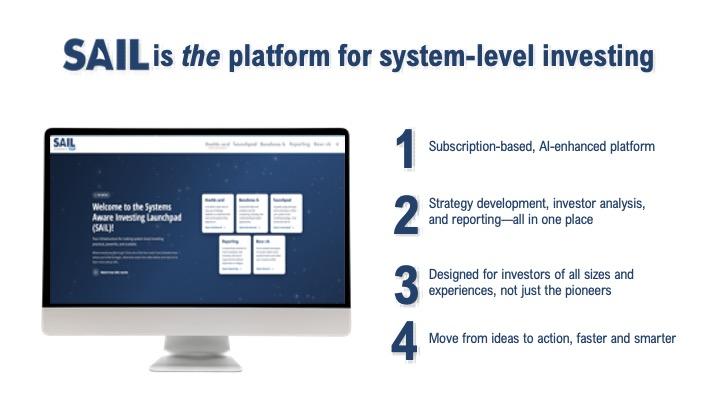
SAIL has a new look! And that’s not all..
- We have streamlined the Reporting page! Reporting helps you meet mandatory and voluntary disclosure requirements without duplication or fatigue.
-
- Auto-populate PRI, GRESB, Stewardship Codes, and other mandatory or voluntary frameworks.
- Upload supporting documents and generate system-aligned reports on demand.
- Interoperable and adaptive — one upload populates multiple frameworks, saving time and reducing duplication.
- The same interface can also run diagnostics on every element of practice.
- Keep all results in the local document library for revisiting, refining, and reusing over time.
- We upgraded Benchmark’s filtering capabilities! If you haven’t looked at it lately, the Benchmark database makes it easier than ever to find what you need.
-
- Compare managers and peers side by side across 20+ system-level themes (we currently have +700 investor profiles in the database).
- Integrate existing financial, sustainability, and impact data to track progress over time.
- Leverage TIIP’s proprietary methodology to assess a range of investors across conventional, sustainable, impact, or system-level investing approaches.
New features coming soon…
- Rolling out by the end of the summer: Rework! Rework will allow Subscribers to fill out questionnaires quickly using content from your Launchpad or other context you upload as PDF files or web links. You can also use it to rewrite policies or other documents, adding new risks you’re considering or current events unfolding in real-time as context. The reworked document will be stored in your DocLibrary on that page.
-
- Auto-populate due diligence questionnaires or prototype policy responses to emerging systemic risks.
- Upload or paste a questionnaire or target document, then rework it, guiding by the additional context you feed it.
- You can further guide the output to include new considerations such as new risks, geographies or current events you want to explore.
- Keep every result in the local document library to revisit, refine, and reuse over time.
- Early next year: Dashboard! Dashboard is a systems-intelligence tool that assesses your whole portfolio — across every asset class and manager — for its real-world influence. (Note that Dashboard will not be part of the Basic Subscription, which includes Launchpad, Benchmark, Reporting, and Rework (when available). Dashboard will be a separate add-on included in the Total Portfolio Subscription.)
-
- Classify holdings as system stabilizers or destabilizers across 12 dimensions.
- Navigate from company to sector to real-economy views, surfacing actionable insights.
- Create governance and investment committee-ready reports and turn portfolio and systems intelligence into effective allocation and stewardship decisions.
Also, Diagnostics and Playbooks are available!
On your behalf, the TIIP team can now run diagnostics on any element of your practice you’d like to assess across the 6 steps outlined in Launchpad. If you’d like a playbook for taking a specific practice, such as stewardship or portfolio construction, to the system level, we can develop one. Or, if you’re thinking through what to do about a specific systemic risk or how to deploy capital in a specific geographic area, we can help with that, too.
- Do you need direct guidance on incorporating total portfolio thinking? Here is our suite of services:
-
- Total Portfolio Activation: Assess your readiness for system-level investing and create a go-forward plan
-
- Total Portfolio Implementation: TIIP provides practical tools and support for integrating system-level strategies into your policies, programs and practices
-
- Total Portfolio Review: Helps investors assess and refine their investment strategies with a systems lens. Many of these assessments have been released publicly in whole or in part as case studies on an investor’s journey
- Do you need a playbook on how to extend a tool to the system-level, address a systemic risk or constellation of risks, or deploy capital in a specific geography?
-
- The Organization-wide System-level Investing Playbook is for the investor ready to align their entire portfolio with long-term systemic outcomes
-
- The Systemic Stewardship Playbook is for those ready to take their stewardship efforts to the system-level
-
- The Asset Class Specific Playbook is for investors seeking a sharper strategy that reflects the unique utility of particular asset classes to contend with a specific systemic risk, or intersection of risks
- Issue Specific Playbooks for a Targeted Geography are for those navigating a pressing issue area — or a tangle of converging risks. We diagnose the systemic dynamics at play in your priority geographic area (whether local, national, regional or global) and deliver actionable guidance tailored to you
- Capital Needs Assessment is for investors or coalitions with a stake in a specific place. We assess the capital gaps in the priority geography — city, state , region, country or area — and build a playbook for deploying capital where and how it’s needed most
👉 Click here to schedule a demo of SAIL or time to explore the other options listed above or email us at [email protected].
Join the Leaders in System-Level Investing
Our expertise has helped inform and support the strategies of pioneering institutions, including CalSTRS, Domini Impact Investments, the Surdna Foundation, University Pension Plan (UPP), Wespath Benefits and Investments, and more.
Are you ready to evolve your investing approach? Together, let’s take your policies, programs, and practices to the system level.
On the Radar
 On June 16, 2026, the CAIA Association and the Thinking Ahead Institute released “An Expanding Mandate” — a systems-level framework for how asset management needs to evolve.
The core argument is that investment practice was built for a world that no longer exists. Backward-looking risk models. Siloed portfolio sleeves. A clean separation between public and private markets. These were reasonable design choices for a stable, linear environment. But the operating environment has changed — and the changes aren’t happening one at a time.
The report reflects on the concept of “polycrisis and simultaneity”, basically that geopolitical fragmentation, climate change, demographic shifts, and AI aren’t just concurrent trends; they interact and amplify each other in ways that traditional models fundamentally can’t capture.
Their diagnosis is that the industry faces a cognitive gap. Systems thinking — genuinely understanding how interconnected, nonlinear systems behave — remains underdeveloped across most investment organizations, precisely when it’s needed most.
Read it for yourself here.
 Quoting Jon Lukomnik from Linkedin as he introduces the article “System-level investing ideas from a European investor tour” published on June 12, 2026
Just a few years ago, the question was whether investors should address systemic risks. Now the questions are far more practical: How should we incorporate thinking about systemic risks into investment belief statements, investment management agreements and other governing documents? What tools actually work? Which activities sound good but are ultimately a waste of time and resources? What are our peers and competitors doing that we can learn from?
In other words, the discussion has moved from “why” to “how”?
William Burckart and I understood that when we wrote “The Handbook of System-level Investing”. The whole purpose was to highlight some of things others are doing as exemplars.
But even that wasn’t enough for many of the investors I met. Talking to them surfaced five more ideas. Together, they formed. The basis of my recent IP&E Column.
Talking with investors, rather than at investors, results in ideas that we can all use. Some may work, some may not. And some may work for some but not for all. But the direction of travel is clear:l system-level investing is moving from a theoretical framework towards practical implementation, as investors increasingly focus on managing the feedback loops between capital markets and the environmental, financial and social systems on which they rely.
Check out the full piece here.
 TIIP Advisory Council Member, Kieron Boyle, published a reflection on his first year at LSE entitled, “Shaping the Impact Economy at LSE: Lessons from Year One”, on June 10, 2026.
“One year after launching the Impact Economy Project, Kieron Boyle argues that the impact economy is both a practical reality and a broader vision for how economies can create shared prosperity, and invites practitioners, researchers, policymakers, students, and funders to help shape its future.”
Read his full blog post here.
 TIIP Advisory Council Member, Renaye Manley, brought the house down in her closing keynote at the IEN Virtual Forum on June 2, 2026 in her session entitled, “Harnessing Power for System-Level Change”.
Session description below:
What actually moves systems? Not data alone—but narrative, institutional leverage, and power. In this closing keynote, Renaye Manley draws on her work at the intersection of labor, capital, and systemic change to examine what it really takes to shift markets and institutions at scale. As the definition of acceptable engagement continues to narrow in some quarters, Manley offers a clear-eyed counter-perspective: the business case was never the primary driver of change, and it won’t be now. System-level investing is ultimately about who shapes the rules, who decides which risks count, and how investors can act with intention in a market of mixed signals.
Follow us on LinkedIn to keep up with the latest TIIP news and find out how to join the system-level investing movement. Have questions about system-level investing? Email us at [email protected].