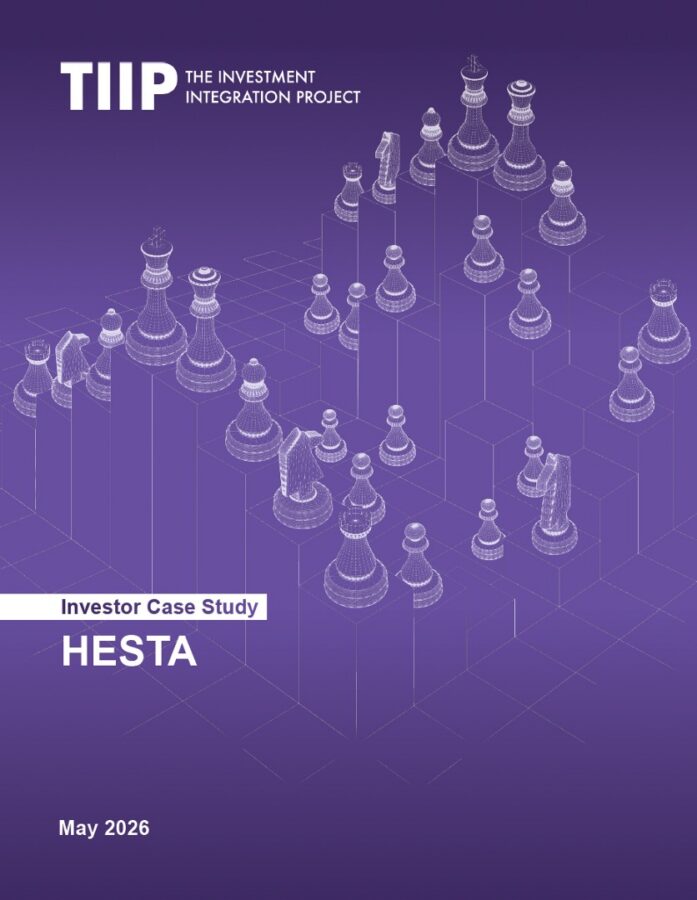
May 12, 2026 – New York, NY – Today, The Investment Integration Project (TIIP) released a comprehensive case study examining how HESTA, one of Australia’s largest industry superannuation funds with AU$102 billion in assets under management, has integrated system-level investing through its Super with impact™ strategy.#
The report offers an in-depth look at how HESTA serves more than 1.05 million members—around 80% of whom are women who mainly work in healthcare and community services—by recognizing that delivering strong long-term returns largely depends on the long-term health of global environmental, social, and financial systems.
We recognize how important a growing, sustainable and inclusive economy is to delivering strong long-term returns for members… As a super fund with diversified global investments, we are structurally exposed to risks related to some of the world’s biggest issues and therefore manage these risks on an ongoing basis.” Said Akaash Sachdeva, Manager of Responsible Investment at HESTA. “System level issues cannot be fully mitigated through diversification or divestment.”
The case study details HESTA’s comprehensive approach across eight priority UN Sustainable Development Goals, including gender equality, climate change, natural capital and biodiversity, decent work, good health and wellbeing, and sustainable cities and communities—all grounded in a total portfolio approach that connects individual, company, and economy-level impacts.
“HESTA’s Super with impact™ strategy demonstrates a profound understanding that fiduciary duty in the 21st century means managing systemic risks that cannot be diversified away,” said William Burckart, CEO of TIIP. “By using their expertise and influence to deliver strong long-term returns while accelerating their contribution to a more sustainable world, HESTA shows how pension funds can be powerful agents of system-level change.”
HESTA’s approach is grounded in understanding that “system level issues cannot be fully mitigated through diversification or divestment.” Instead, they use three strategic levers: advocacy for systemic change, active ownership through engagement and voting, and capital allocation aligned with sustainability outcomes.
Key highlights include:
- AU$102 billion in assets under management serving more than 1.05 million members
- 1,680 company engagements in 2025 on responsible investment themes
- 14.6% of portfolio (AU$14.5 billion) invested in alignment with the SDGs
- 6.4% of portfolio (AU$6.4 billion) invested in climate solutions with a 10% target by 2030
- 41% reduction in normalized portfolio emissions from 2020 baseline
- Founding member of 40:40 Vision initiative achieving gender balance in executive leadership
- Leadership roles across Investor Group on Climate Change, Climate Action 100+, Nature Action 100, Australian Sustainable Finance Institute, and International Corporate Governance Network
Importantly, HESTA emphasizes the power of collective action for tackling systemic issues. As detailed in its Responsible Investment Policy, collaboration with peers helps the fund to efficiently and effectively amplify its voice and drive action, helping to improve the sustainability of capital markets, send consistent messaging to companies and policymakers and deliver economies of scale.
The report also highlights how HESTA connects the dots: housing affordability can affect their members’ retirement security AND workforce retention AND economic productivity. Gender equality benefits individuals, companies, and could boost Australia’s GDP by AU$128 billion annually. Climate impacts on healthcare create risks for both their members’ workplaces and their investment portfolios.
“HESTA demonstrates how understanding your members’ lived experiences can inform a sophisticated system-level investing strategy,” said Monique Aiken, TIIP’s Managing Director. “By connecting the dots between housing affordability, gender equality, workplace culture, and climate impacts on the healthcare sector, HESTA shows how systemic issues intersect—and how investors can address them holistically.”
This report is part of TIIP’s Total Portfolio Review (TPR) series examining how leading institutional investors are implementing system-level investing strategies to address systemic risks while fulfilling fiduciary duties.
Download the full report here.
Acknowledgements: This report was researched and written by TIIP’s Melissa Eng, William Burckart, Monique Aiken and Jessica Ziegler with design support from Alex Lumelsky at SKY Creative.
About The Investment Integration Project (TIIP)
The Investment Integration Project (TIIP) is a boutique consulting firm that helps institutional investors 1) understand how portfolio performance is intertwined with the health of environmental, social, and financial systems; 2) shape the structures and norms influencing those systems; and 3) embed systems-aware decision-making across all strategies and operations.
Established in 2015 by Steve Lydenberg and William Burckart—who coined the term system-level investing—TIIP’s pioneering thought leadership has enabled the alignment of investment practices with the long-term health of the systems underpinning value creation. At the center of TIIP’s work is SAIL (Systems Aware Investing Launchpad), an enterprise management and data platform that enables investors to integrate system-level investing across strategy, implementation, and governance. TIIP also offers customized services—Total Portfolio Activation, Total Portfolio Implementation, and Total Portfolio Review—to help clients benchmark progress, enhance portfolio design and stewardship, and apply system-level thinking in practice.
About the HESTA
HESTA is one of the largest superannuation funds dedicated to Australia’s health and community services sector. An industry fund that’s run only to benefit members, HESTA now has more than one million members (around 80% of whom are women) and currently manages approximately $102 billion* in assets invested around the world.
*Information is current as at the date of issue.
# For more information on Super with impact™ go to https://www.hesta.com.au/impact