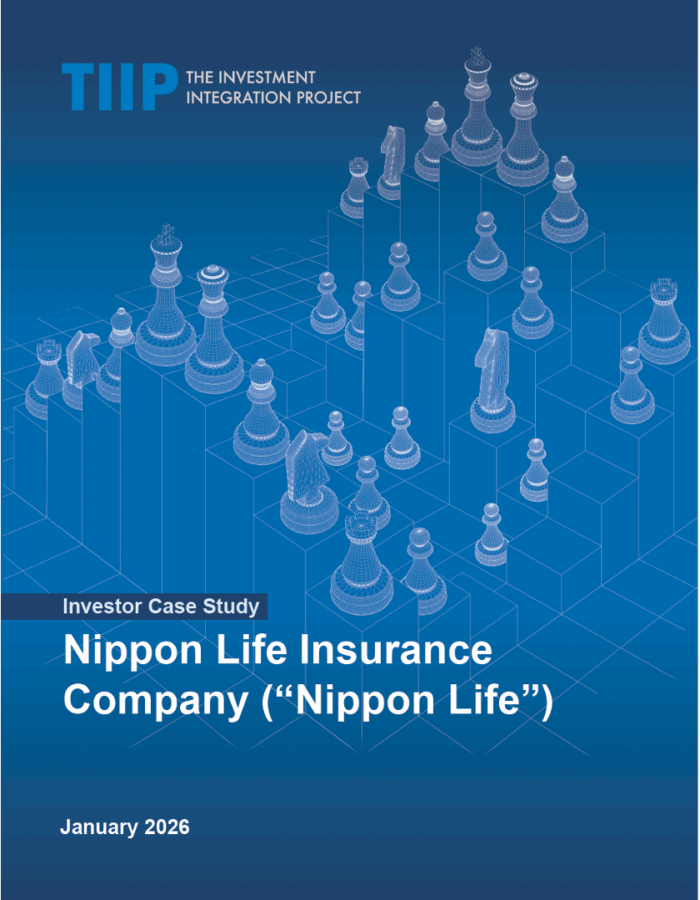
January 21, 2026 – New York, NY – Today, The Investment Integration Project (TIIP) released a comprehensive case study examining how Nippon Life Insurance Company, Japan’s largest private asset owner with ¥83,549 billion in assets, has chartered a course toward system-level investing through its innovative “P-squared Investing” framework that connects People and Planet.
The report offers an in-depth look at how Nippon Life has integrated systems thinking into its investment strategy, recognizing that environmental stability, social well-being, and financial performance are profoundly interconnected—and that long-term market returns ultimately depend on the health and resilience of the systems that underpin them.
While it is possible to earn excess returns by investing in companies with innovative technologies, this alone is not sufficient to address system-level risks,” said Takeshi Kimura, Special Adviser to the Board at Nippon Life. “Making the entire financial system sustainable is essential for institutional investors to improve the long-term investment performance of their overall portfolios. This is why systems thinking is required of responsible investors.”
The case study details Nippon Life’s comprehensive approach across three core sustainability areas—people, community, and environment—with particular focus on addressing the systemic environmental issue of climate change through real-world decarbonization objectives.
“Nippon Life’s concept of being ‘future makers’—not just ‘future takers’—signals a profound shift in mindset,” said William Burckart, CEO of TIIP. “It reflects the recognition that institutional investors are not passive observers of the future, but active participants in shaping it. Nippon Life is a leading example of this evolution: clarifying beliefs, integrating systems thinking, advancing transition-finance standards, and engaging peers and policymakers to mitigate economy-wide risks.”
Nippon Life’s system-level investing strategy is built on two strategic pillars connected by norm-setting: guardrails (investor-defined internal boundaries ensuring investment activities don’t undermine environmental and social systems) and standard-shaping (field-building and system-level stewardship that influence industries, markets, and policy frameworks).
Key highlights include:
• ¥2.6 trillion invested in sustainability-themed solutions as of March 2024
• ¥1.9 trillion in decarbonization financing facility investments
• 4.27 million tonnes of greenhouse gas emissions reduced (April 2023-March 2024)
• 45.9% reduction in total portfolio emissions (compared with 2010)
• 88% of top emitters have disclosed emissions reduction roadmaps
• Development of groundbreaking Transition Finance Framework to support companies in meeting 1.5°C pathways
• Leadership roles across major sustainability initiatives including PRI Board of Directors, NZAOA Steering Group, GFANZ Japan Chapter, and TISFD Steering Committee
“Nippon Life has established the P-squared perspective as a norm embedded internally as the design principle for investment guardrails, and externalized as a compass for standard-shaping activities,” explained Kimura. “Guardrails and standard-shaping are like the two wheels of a single vehicle, connected by norm-setting as the axle. Only when combined strategically can they address system-level risks effectively.”
The report also highlights Nippon Life’s commitment to stakeholder engagement, with over 80% of policyholders expressing the expectation that the company should pursue sustainability outcomes alongside financial returns through its investment activities.
“At a time when the interconnectedness of our shared challenges amplifies system-level risks, Nippon Life demonstrates how institutional investors can fulfill their fiduciary responsibilities by recognizing that portfolio value depends on system health and responding to that understanding accordingly,” said Melissa Eng, TIIP’s Impact Measurement and Management Specialist.
This report is part of TIIP’s Total Portfolio Review (TPR) series examining how leading institutional investors are aligning capital, governance, and influence with long-term, system-level goals.
Read the report here.
Acknowledgements: This report was researched and written by TIIP’s Melissa Eng, William Burckart, Monique Aiken and Jessica Ziegler with design support from Alex Lumelsky at SKY Creative.
About The Investment Integration Project (TIIP)
The Investment Integration Project (TIIP) is a boutique consulting firm that helps institutional investors 1) understand how portfolio performance is intertwined with the health of environmental, social, and financial systems; 2) shape the structures and norms influencing those systems; and 3) embed systems-aware decision-making across all strategies and operations.
Established in 2015 by Steve Lydenberg and William Burckart—who coined the term system-level investing—TIIP’s pioneering thought leadership has enabled the alignment of investment practices with the long-term health of the systems underpinning value creation. At the center of TIIP’s work is SAIL (Systems Aware Investing Launchpad), an enterprise management and data platform that enables investors to integrate system-level investing across strategy, implementation, and governance. TIIP also offers customized services—Total Portfolio Activation, Total Portfolio Implementation, and Total Portfolio Review—to help clients benchmark progress, enhance portfolio design and stewardship, and apply system-level thinking in practice.
About Nippon Life Insurance Company
Nippon Life Insurance Company is Japan’s largest life insurer and one of the world’s leading institutional investors. Founded in 1889, the company has a long history of supporting the financial security and well-being of individuals, families, and communities across Japan. Operating as a mutual company, Nippon Life takes a long-term perspective that prioritizes policyholders’ interests and financial stability.
Nippon Life also operates as a global insurance group, with an international presence across the United States, Asia, and Australia through insurance-related and investment activities, and maintains a European footprint mainly through asset management operations. Through its large and diversified investment portfolio, the company is actively engaged in responsible investment, stewardship, sustainability initiatives, and system-level risk management. As a signatory and board member of the UN-supported Principles for Responsible Investment (PRI), Nippon Life contributes to global efforts to enhance the resilience and long-term sustainability of financial and economic systems.