Confronting Complexity: A Design Guide for System-level Investors
She Ji: The Journal of Design, Economics, and Innovation. Volume 12, Issue 2, Summer 2026
Edited by Jordan Ostapchuk and Carlos Teixeira
In this piece, Jon Lukomnik and William Burckart lay out eight design principles, split between ensuring investors focus on material systemic risks (Consensus, Relevance, Effectiveness, Magnitude) and helping build healthier real-world systems (Adaptability, Clarity, Connectivity, Directionality).
They pair these with a three-part taxonomy of tools, Investment Enhancement, Field Building, and Opportunity Generation, to help investors navigate the complexity of system-level investing.
The article draws on real-world examples of system-level investing in action at CalSTRS, Domini Impact Investments, HESTA, Wespath, University Pension Plan Ontario, PGGM, the Church of England, The People’s Pension, the New York State Common Retirement Fund, and Caisse de dépôt et placement du Québec (CDPQ).
Abstract below:
For most investors, the function of investing is to offset future liabilities, such as retirement. Yet, most investors define success as “beating a benchmark,” rather than funding the future.
That misalignment, and the limited design decisions associated with it, stems from Modern Portfolio Theory (MPT), which treats the general price level of the market as exogenous. Recently, the assumption that you cannot impact beta has been challenged by system-level investing. By reducing risk to the environmental, social, and financial systems on which the capital markets rely, system-level investors attempt to improve the overall risk/return profile of the capital markets, which determines 75–94 percent of the variability of your return. But if traditional, MPT-driven investment follows well-trodden paths, system-level investing is bushwhacking through a dynamic real-world landscape.
To facilitate that, we propose a set of design principles: Consensus, Relevance, Effectiveness, and Magnitude, to ensure investors focus on material systemic risks; Adaptability, Clarity, Connectivity, and Directionality, to help create healthy real-world systems. To achieve those goals, we provide a three-part taxonomy of tools: Investment Enhancement, Field Building, and Opportunity Generation. These design rules help investors cut through the complexity of system-level investing to improve the total risk/return profile rather than trying to beat a benchmark.
Read the full piece here.
System-level Investing Redux: 2 Videos
As promised, over the next few months, we will continue to release the remaining videos from TIIP’s 5th Annual Symposium on System-level Investing, From Ambition to Action, held on April 14, 2026, to support shared learning and help all of us continue getting smarter together.
Each post will include the session description, presentation slides (where available), and video recording. If anything you see or hear sparks questions, ideas, or reflections, we’d love to hear from you. We’re always eager to learn what’s resonating—and to help unpack some of the complex concepts explored throughout the day.
Reach out to us anytime at [email protected]
Dialogue: Field Building for System-level Influence
Internal guardrails and standards achieve scale only when supported by coordinated field-level action. Featuring Cambria Allen-Ratzlaff (PRI), Fran Seegull (USIIA), Georges Dyer (IEN), and Josh Zinner (ICCR), this session examined field building as a critical—but often underappreciated—lever for system-level investing. Moderated by Chavon Sutton of Cambridge Associates, panelists explored how investors can shape shared norms, information flows, and policy environments, and why collaboration with peers—including competitors—is often essential to addressing risks no single investor can manage alone.
Case Study: Aligning Ideas, Institutions, and Practice in System-level Investing
As system-level investing gains conceptual acceptance, its practical adoption has proven uneven and context-dependent. Takeshi Kimura (Special Adviser to the Board @ Nippon Life Insurance, Board Director @ PRI and inaugural recipient of the Catalyst
Award for System-level Investing) explores why a compelling idea has struggled to translate into consistent practice—and what that reveals about the current stage of the field’s evolution. Drawing on the perspective of a universal owner, Kimura argues that system-level investing is less a discrete strategy than a way of reframing risk and responsibility in markets not designed to accommodate systemic concerns.
What’s New With SAIL?
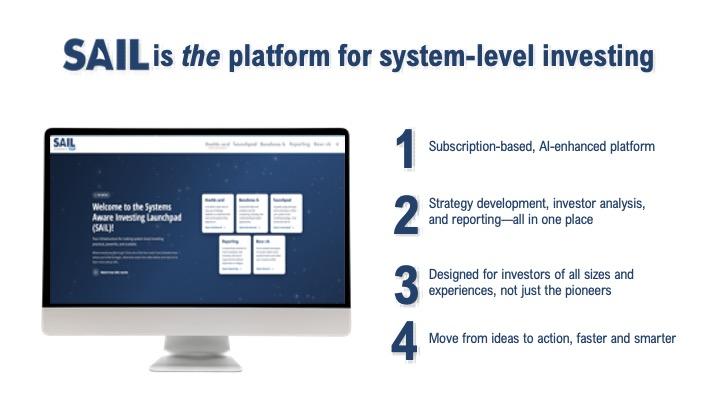
SAIL has a new look! And that’s not all..

- We have streamlined the onboarding and included Diagnostics in Launchpad page!
- Upload supporting documents and generate diagnostics related to various dimensions of practice on demand.
- Keep all results in the local document library for revisiting, refining, and reusing over time.
 We upgraded Benchmark’s filtering capabilities! If you haven’t looked at it lately, the Benchmark database makes it easier than ever to find what you need.
-
- Compare managers and peers side by side across 20+ system-level themes (we currently have +700 investor profiles in the database).
- Integrate existing financial, sustainability, and impact data to track progress over time.
- Leverage TIIP’s proprietary methodology to assess a range of investors across conventional, sustainable, impact, or system-level investing approaches.
New features coming soon…

- Rolling out by the end of the summer: Rework! Rework will allow Subscribers to fill out questionnaires quickly using content from your Launchpad or other context you upload as PDF files or web links. You can also use it to rewrite policies or other documents, adding new risks you’re considering or current events unfolding in real-time as context. The reworked document will be stored in your DocLibrary on that page.
-
- Auto-populate due diligence questionnaires or prototype policy responses to emerging systemic risks.
- Upload or paste a questionnaire or target document, then rework it, guiding by the additional context you feed it.
- You can further guide the output to include new considerations such as new risks, geographies or current events you want to explore.
- Keep every result in the local document library to revisit, refine, and reuse over time.

- Early next year: Dashboard! Dashboard is a systems-intelligence tool that assesses your whole portfolio — across every asset class and manager — for its real-world influence. (Note that Dashboard will not be part of the Basic Subscription, which includes Launchpad, Benchmark, Reporting, and Rework (when available). Dashboard will be a separate add-on included in the Total Portfolio Subscription.)
-
- Classify holdings as system stabilizers or destabilizers across 12 dimensions.
- Navigate from company to sector to real-economy views, surfacing actionable insights.
- Create governance and investment committee-ready reports and turn portfolio and systems intelligence into effective allocation and stewardship decisions.
Also, Diagnostics and Playbooks are available!
On your behalf, the TIIP team can now run diagnostics on any element of your practice you’d like to assess across the 6 steps outlined in Launchpad. If you’d like a playbook for taking a specific practice, such as stewardship or portfolio construction, to the system level, we can develop one. Or, if you’re thinking through what to do about a specific systemic risk or how to deploy capital in a specific geographic area, we can help with that, too.
- Do you need direct guidance on incorporating total portfolio thinking? Here is our suite of services:
-
- Total Portfolio Activation: Assess your readiness for system-level investing and create a go-forward plan
-
- Total Portfolio Implementation: TIIP provides practical tools and support for integrating system-level strategies into your policies, programs and practices
-
- Total Portfolio Review: Helps investors assess and refine their investment strategies with a systems lens. Many of these assessments have been released publicly in whole or in part as case studies on an investor’s journey
- Do you need a playbook on how to extend a tool to the system-level, address a systemic risk or constellation of risks, or deploy capital in a specific geography?
-
- The Organization-wide System-level Investing Playbook is for the investor ready to align their entire portfolio with long-term systemic outcomes
-
- The Systemic Stewardship Playbook is for those ready to take their stewardship efforts to the system-level
-
- The Asset Class Specific Playbook is for investors seeking a sharper strategy that reflects the unique utility of particular asset classes to contend with a specific systemic risk, or intersection of risks
- Issue Specific Playbooks for a Targeted Geography are for those navigating a pressing issue area — or a tangle of converging risks. We diagnose the systemic dynamics at play in your priority geographic area (whether local, national, regional or global) and deliver actionable guidance tailored to you
- Capital Needs Assessment is for investors or coalitions with a stake in a specific place. We assess the capital gaps in the priority geography — city, state , region, country or area — and build a playbook for deploying capital where and how it’s needed most
👉 Click here to schedule a demo of SAIL or time to explore the other options listed above or email us at [email protected].
Join the Leaders in System-Level Investing
Our expertise has helped inform and support the strategies of pioneering institutions, including CalSTRS, Domini Impact Investments, the Surdna Foundation, University Pension Plan (UPP), Wespath Benefits and Investments, and more.
Are you ready to evolve your investing approach? Together, let’s take your policies, programs, and practices to the system level.
On the Radar
 June 25, 2026 William Burckart and Megan Kashner penned “What the market taught us about LGBTQIA+ equity”, on ImpactAlpha.
In celebration of Pride Month, we’re honored to spotlight a new article by William and Megan, the co-founders of Colorful Capital. Their perspective is grounded in the belief that understanding our shared history is essential to building a more inclusive future. As covered in the report Outsized Impact: How Investment Can Address the Systemic Risk of LGBTQIA+ Inequity, learning that history can be a powerful entry point: it helps reveal how systematic dehumanization, economic exclusion, and physical harm were embedded in policy, practice, and culture—and how those forces continue to shape American life today.
While this history has particular resonance in the United States, the broader lessons are global. Across geographies, the legacies of colonization, exclusion, and inequity continue to shape who has access to opportunity, safety, capital, and voice. Pride Month invites us to honor the people and movements that have pushed society to expand its imagination of freedom—and to recognize that the work of equity is interconnected across race, gender, sexuality, identity, and place.
William and Megan also remind us that the cost of inequity is not only moral—it is material. When people and communities are excluded from full participation, society leaves tremendous human potential and economic value unrealized. The question, then, is not only what inequity has cost us, but how much more abundance, creativity, and shared prosperity is possible when everyone is able to participate fully.
That was the animating spirit behind Colorful Capital: a commitment to helping communities see themselves—and one another—with more love, dignity, and possibility. As we celebrate Pride Month, we celebrate the courage it takes to live fully, the creativity it takes to build more inclusive systems, and the collective responsibility we share to create a world where every person can thrive.
At TIIP, Pride is not only a moment of celebration—it is a reminder of the work still ahead, and the urgency to advance a vision of belonging that is joyful, justice-oriented, and rooted in the belief that the future can be more expansive than the systems we inherited.
Read the full article here.
July 15, 2026 3 Systemic Stewardship Levers Every Institutional Investor Needs
In this episode, Georges Dyer is joined by Caroline Escott. Head of Investment Stewardship and Co-Head of Sustainable Ownership at Railpen, the in-house manager for the UK Railways pension schemes overseeing £34 billion on behalf of over 350,000 members.
Together they walk through Railpen’s December 2025 case study “Systemic Stewardship: The Financially Material Imperative” produced with the Investment Integration Project (TIIP) and Sinclair Capital, distilling five years of live implementation into a framework any asset owner can learn from.
Check out the podcast here.
Follow us on LinkedIn to keep up with the latest TIIP news and find out how to join the system-level investing movement. Have questions about system-level investing? Email us at [email protected].